A Depot owned by professional Vietnamese tour operators, which is for any travelers who may need any travel stuffs!!!
Mar 28, 2010
WATERWAY TRAVEL BY VIETNAM TRAVEL DEPOT
The tours will take passengers from the wharf on Saigon River to visit Cuchi Tunnels, Can Gio Eco-Park or Mekong Delta’s favorite destinations of My Tho in one day. For those who whish to discover Mekong in deep can travel down to Can Tho and spend one night at provided hotels.
The speed boats are also available for rent on hour-basis to take short excursions along Saigon River and visit some spots such as Binh Quoi Tourist Village, Go Vap Temples or simply see how different Saigon is from the water view.
This is a new way of discovering the travel spots of Southern Vietnam as conventionally passengers have only an option of travel by road which sometimes takes longer because of the busy traffic.
Details of programs and rates please contact the travel advisers at sales(at)vietnamtraveldepot.com or call +84 – 8 – 6290 6577
Cuchi Tunnels: immense network of connecting underground tunnels located in Cu Chi District of Hochiminh City. The Cu Chi tunnels were the location of several military campaigns during the Vietnam War.
Mekong Delta: Nine Dragon River Delta in local term is the region in southwestern Vietnam where the Mekong River approaches and empties into the sea through a network of distributaries. The Mekong delta region encompasses a large portion of southeastern Vietnam of 39,000 square kilometers (15,000 sq miles). This is the hub of rice, fish and other key agricultural products of the country.
Vietnam Travel Depot: Vietnam specialized travel services for individuals and small group travelers. Visit www.vietnamtraveldepot.com for more of company special deals and extensive Vietnam travel offers.
Jan 31, 2010
Cu Chi Jeep Tour by Vietnam Travel Depot (New, Extremely Hot!!!!)
At 10.00 am, from Saigon, we hopped on Jeeps and drove to Cu Chi Tunnels for a new hot adventure. Our “land - force” were tourists, operators from Vietnam Jeep Tours (Vietnam Travel Depot) and 11 jeeps (A1, A2).
Arrived Cu Chi Tunnels at 12.00 am, everyone was too exciting to wait for discover Tunnels – an amazing complex of underground tunnels used during the Vietnam War – the Viet Cong’s Under World: an elaborate underground community made up of 250 km of tunnels and chambers below the city and which was built with simple tools and bare hand.
Here are some real photos and video clip from this jeep tour. Hope you love this and will join us some days!
Hope you love this and will join us some days!
Vietnam Jeep Tours (Vietnam Travel Depot)
The only one who makes everything different with Jeeps!
Ph: +84 98 924 5868
Jan 18, 2010
Five more luxury hotels operational in Hanoi for National Tourism Year
Hanoi plans to put into operation five more luxury hotels, offering an additional 2,000 rooms during National Tourism Year 2010.They include four five-star hotels, namely Hanoi Plaza, with 600 rooms, the PetroVietnam hotel complex with 350 rooms, Keang Nam Vina complex with 500 rooms and Crowne Plaza Hanoi, 393 rooms.
The city now boasts 213 hotels with nearly 10,000 rooms, including 36 three to five-star hotels.
Last year, the room occupancy rate was 55.41%, a fall of 21.7% compared to 2008.
The average duration of stay was 2 days per foreign tourist who came from major markets as Japan, the Republic of Korea, France, Australia, China and ASEAN countries.
The city’s tourism sector expects a surge in the number of foreign tourists during the national tourism year, helping raising the rate of hotel room occupancy.
(Source: VNA)
Oct 16, 2009
Vietnam Travel Depot Launches Jeep Adventure
Hochiminh City, 16 October 2009 - Vietnam Travel Depot has launched Jeep tours for the adventure enthusiasts. The unconventional tours by the US military Jeep M151 A1 and M151 A2 - vehicles once used in the Vietnam War will cover famous destinations such as historic Cu Chi Tunnel, Cao Dai Temple, Vung Tau Beach & Australia War Memorial, Mui Ne Beach, up to the mountain of Dalat or Central Highland or deep into the forest of Nam Cat Tien National Park.
About Vietnam Jeep Tours
Oct 5, 2009
Ca Tru and Quan Ho folksongs recognized by UNESCO
Ca Tru is chamber music in which the singer is rewarded for each of her successful passages by bamboo tablets, which can be converted into money.
The recognised heritage will immediately be registered on the Representative List of the Intangible Cultural Heritage of Humanity or the Intangible Cultural Heritage in Need of Urgent Safeguarding and will be preserved at an international level.
A day earlier, Quan Ho was also recognized by UNESCO in the same category of Ca Tru.
Quan Họ folk songs form the northern provinces of Bac Ninh and Bac Giang, are performed as alternating verses between two women from one village who sing in harmony and two men from another village who respond with similar melodies, but with different lyrics.
More than 119 cultural items from 34 nations have been nominated as an Intangible Cultural Heritage in Need of Urgent Safeguarding but only 15 have been approved.
Vietnam has been commended for its vision in preserving its cultural heritages. Next, the country will nominate its Giong Festival and Xoan singing.
(Source: VOV)
Sep 30, 2009
Folk music is a mere phone call away
At a time when the modern music industry in Viet Nam is producing mostly flash-in-the-pan pop stars, modern technology is starting to prove convenient in keeping traditional music alive.
The 87 - year - old lady is performing folk songs on mobile
Fans of quan ho (love duets from the northern province of Bac Ninh) no longer need to visit the province to enjoy live performances of this ancient folk music.
Now the music is just a phone call away.
Thanks to such clubs as the Hoa Dinh Club in Hoa Dinh Village, Bac Ninh City, quan ho fans can dial in to listen to their favourite love songs, performed live by well-known singers.
With modern technology often distracting from the country’s traditions, it’s a refreshing change to see it help promote an ancient art form for Vietnamese everywhere.
The Hoa Dinh Club’s head, Tran Van Quyen, says most customers who phone in requesting songs are overseas Vietnamese and people in other provinces.
"It all started at a quan ho singing competition and festival in Spring 2008," he recalls.
During the festival, the club’s artists met with many tourists who said they wanted to enjoy these folk songs from home.
"At the end of the festival, we returned to our day jobs. The quan ho singers of Hoa Dinh Village continued to practise every Saturday evening.
"One day, some of the tourists who had my mobile phone number called me, saying that they wanted to enjoy some songs. We couldn’t refuse their passion for the music," he says.
At present, the club has 51 members, including elder, middle-aged and young people. The oldest member Nguyen Thi Bay is 85, but she still isn’t too old to teach young people how to properly sing the classic melodies.
Bay and other club members are ready to sing via mobile phones to fans, free of charge.
"The most important thing that we gain is that we can popularise the culture of quan ho and images of quan ho artists who are friendly and hospitable to people both in the country and abroad," he says.
"We don’t join the club for money," says artist Nguyen Thi Ly. "We are determined to preserve the ancient folk songs and we want the songs to be handed down to future generations."
The director of Bac Ninh Province’s Culture, Sports and Tourism Department, Dang Van Tuc, said the service has received a lot of attention.
"This service also helps popularise quan ho to the world. We want quan ho to be recognised one day as a UNESCO heritage. During this time of international integration, people all over the world can simply pick up their cell phones and listen to songs by famous singers."
Recognising the potential of wireless communication, the department has asked the provincial People’s Committee to give each quan ho club a mobile phone to help boost this service.
For many old people living in rural villages, mobile phones have been an unaffordable luxury, but there has been a recent spike in the number of elderly with mobile phones.
According to artist Nguyen Thi Thuy, quan ho is an acquired taste, and not everyone wants to listen to these old folk songs.
"That’s why we the quan ho singers always respect the requests of people who really want to listen to the songs. Among them, many are overseas Vietnamese who visited the homeland but didn’t have a chance to visit Bac Ninh," she says.
During the summers, the club also organises classes to teach quan ho to children in the village.
Other than the Hoa Dinh Club, many other clubs have been formed, attracting new performers and fans. They include clubs in Dao Xa Village in Phong Khe Commune, Bac Ninh City, and Diem Village in Hoa Long Commune.
The Ministry of Culture, Sports and Tourism is completing files on quan ho to submit to UNESCO, asking the organisation to recognise the music as an intangible part of their culture.
Just as modern technology seems to facilitate cheaply produced music, this original use of cell phones proves that tradition does not have to be traded for modernity. This also proves that quan ho culture still has a strong presence.
| Club telephone numbers The following clubs provide live performances on Saturday evenings. Fans can listen in by calling: Hoa Dinh Club in Hoa Dinh Village, Bac Ninh City Dao Xa Village Club in Phong Khe Commune 0241 246 329 Diem Village Club in Hoa Long Commune 0241 862 092 |
(Source: VNS & VietNamNet Bridge )
Sep 24, 2009
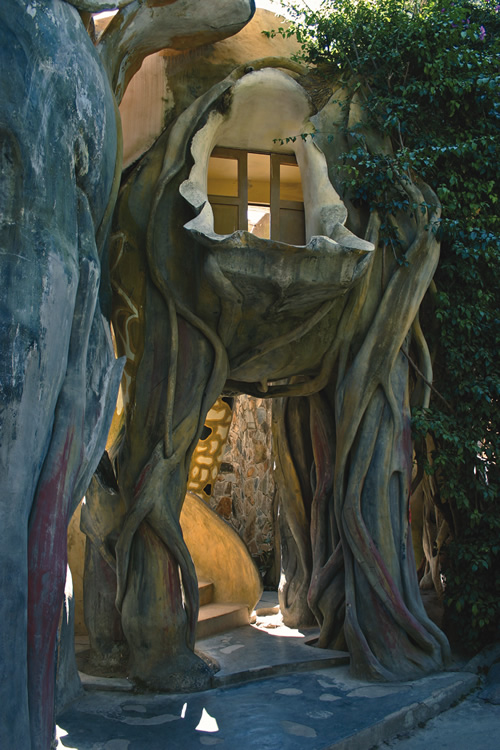
Dalat “Crazy House” joins bizarre global list
A uniquely odd architectural work in the Central Highlands city of Dalat , has been shortlisted by the Chinese People’s Daily as one of the world’s ten most bizarre buildings.
French travel guide Hachette has also highlighted the “Crazy House” as a not-to-be missed hotel stay on any trip to Vietnam.
The house, occupying nearly 1,600m² on Huynh Thuc Khang Street, was completed in 1990 as a personal project by architect Dang Viet Nga. The controversial building once dismissed as “crazy” has now become a regular feature on tourist visits to the city.
The free-form undulating structure is quite unlike anything else in Dalat, let alone Vietnam. The house is constructed on a numerous levels with a naturalistic theme interpreted through concrete curves, twists and bends, giving it the appearance of an out-grown tree. The interior is equally unorthodox, with almost every surface twisting, curving and running fluidly along the internal corridors, stairwells and rooms.
The building has been dogged by controversy since conception with arguments centering on the structure’s insufficient architectural integrity, ad-hoc character and lack of formal aesthetic.
Nga shrugs off criticism, “Many people have criticised me, even my colleagues. I don’t blame who don’t understand me.” Instead she believes that the controversial character of the house has won her more attention.
“When they first saw the house, people would exclaim that it was a “crazy house”! So that’s how it got its name, and now, it’s one of Dalat’s leading tourist attractions,” Nga says.
Nga is more concerned with conveying history and myth through the structural and decorative styling of the house rather than conforming to strict architectural rules. The house for her is interconnected by “a cobweb, which can be conceived as a bridge linking reality and the spiritual world, linking the self and the infinite universe,” she says.